Understanding learning variability to personalise training and boost knowledge-driven, efficient & acceptable neurotechnologies
This website is currently under construction. At this stage, it provides a landing page with general information about the VARIABILITI project. More detailed content will be added progressively as the project develops.
Key features
Quick overview of the project
Boosted by recent advances in neuroscience, AI and wearable sensors, neurotechnologies, and in particular brain-computer interfaces (BCIs), are increasingly presented as near-future solutions to restore, replace or even enhance movement, communication and cognition.
They are envisioned, for example, to support motor rehabilitation after stroke, enable control of assistive technologies, or offer new forms of cognitive enhancement and interaction in virtual environments. Yet, in reality, BCIs remain insufficiently usable and reliable to be adopted in everyday life. Their performance is inconsistent and highly dependent on the individual user, creating a risk of disillusionment, funding loss and stalled innovation if expectations are not met.
VARIABILITI addresses this challenge by training 14 DCs with R-COP (responsible, collaborative, open and participatory) principles, placing end-users at the core of the research and innovation (R&I) loop. By moving from a technology-centred to a human-centred approach, VARIABILITI’s overarching ambition is to make BCIs truly usable, acceptable and efficient.
VARIABILITI unites an international, interdisciplinary and intersectoral consortium of 30 partners including academics, clinicians, SMEs/industrials, and European networks’ to answer four interconnected objectives:
OBJECTIVE 1
Initiate a paradigm shift toward sustainable, user-centred and responsible R&I in BCI
OBJECTIVE 2
Model human learning and its variability to enable co-adaptive, personalised BCIs
OBJECTIVE 3
Design & validate novel BCI protocols and algorithms to enhance the double learning process
OBJECTIVE 4
Demonstrate the relevance and applicability of the Variabiliti approach in clinical and non-clinical contexts
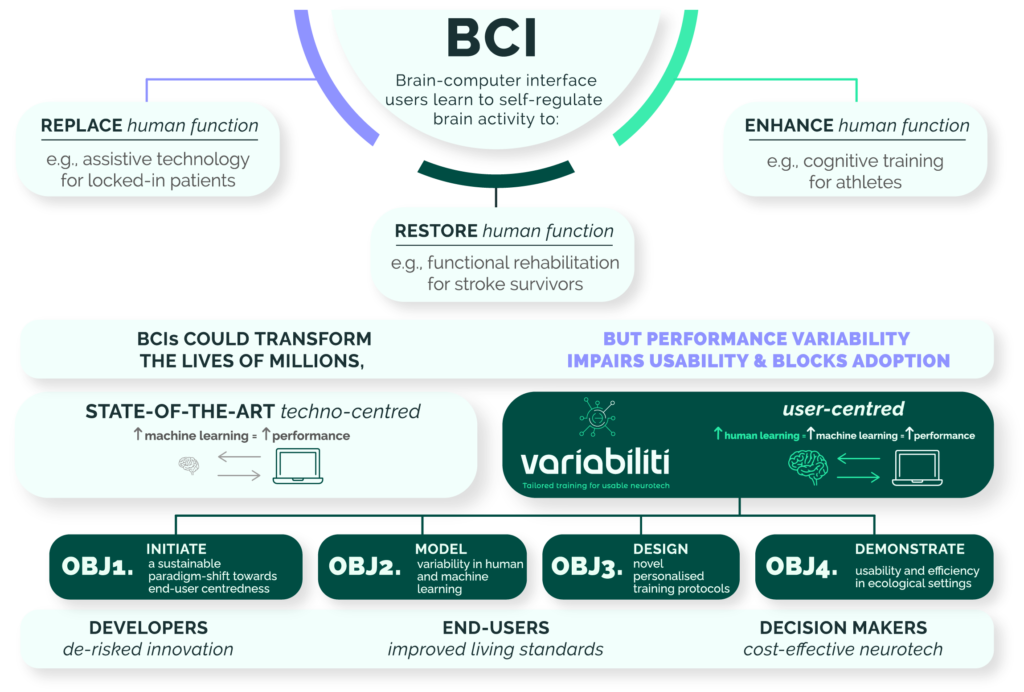
Open datasets, models, protocols and prototypes, and know-how of the next generation of BCI R&I experts will benefit BCI developers, end-users and decision-makers, strengthen Europe’s innovation capacity and support the emergence of responsible, inclusive and high-impact neurotechnologies.
Each recruited DC will be awarded a double or joint diploma from 2 Universities of 2 different countries. Their supervisory team will include their 2 supervisors as well as 1 or 2 other members of the consortium who will host them for secondments. Supervisory teams are international, interdisciplinary and intersectoral.
A graphical representation of the DC Network is presented below. Please click HERE for more information on the persons and institutions involved as well as for a rough description of the PhD topics.
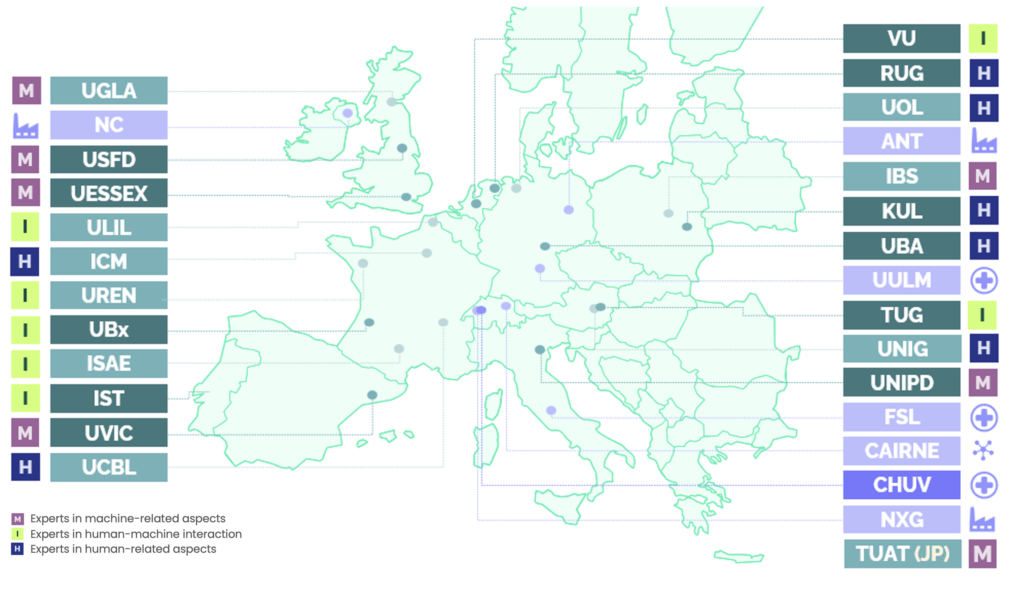
28 academic, industrial and clinical partners
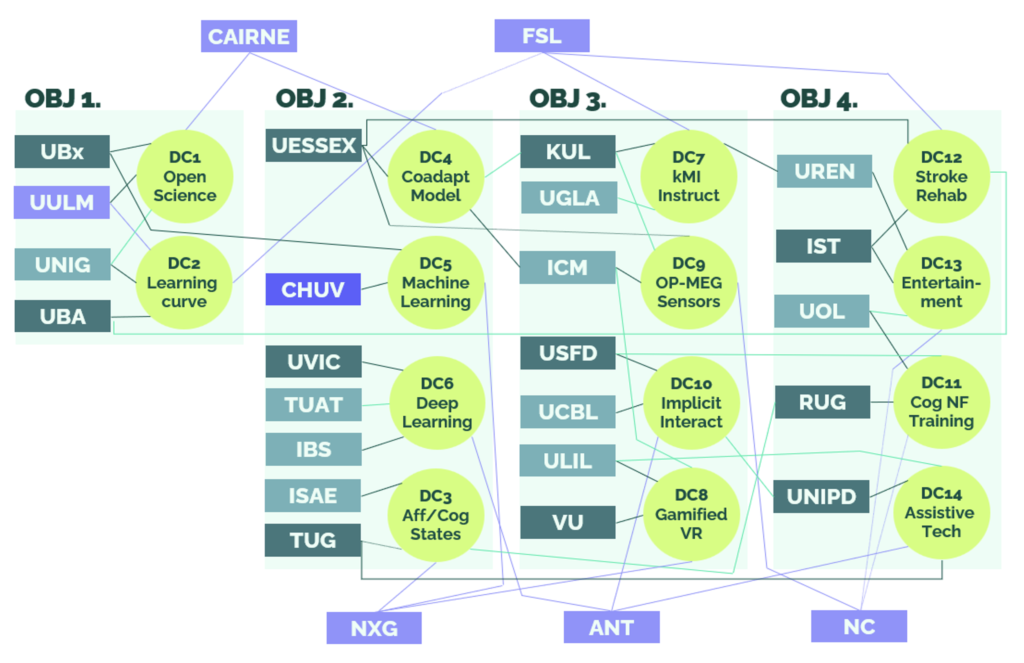
14 doctoral candidates (DCs) in co-supervision
Indicative timeline
Note 1: Candidate can apply to several topics.
Note 2: As shown herein-above, some DC projects will last 36 months, others 48 months. Also, 5 DC projects will start in October 2028 and not in 2027. For those, a second recruitment campaign will be organised from end 2027.